 Skip to content
What IPTV Means in Simple Terms
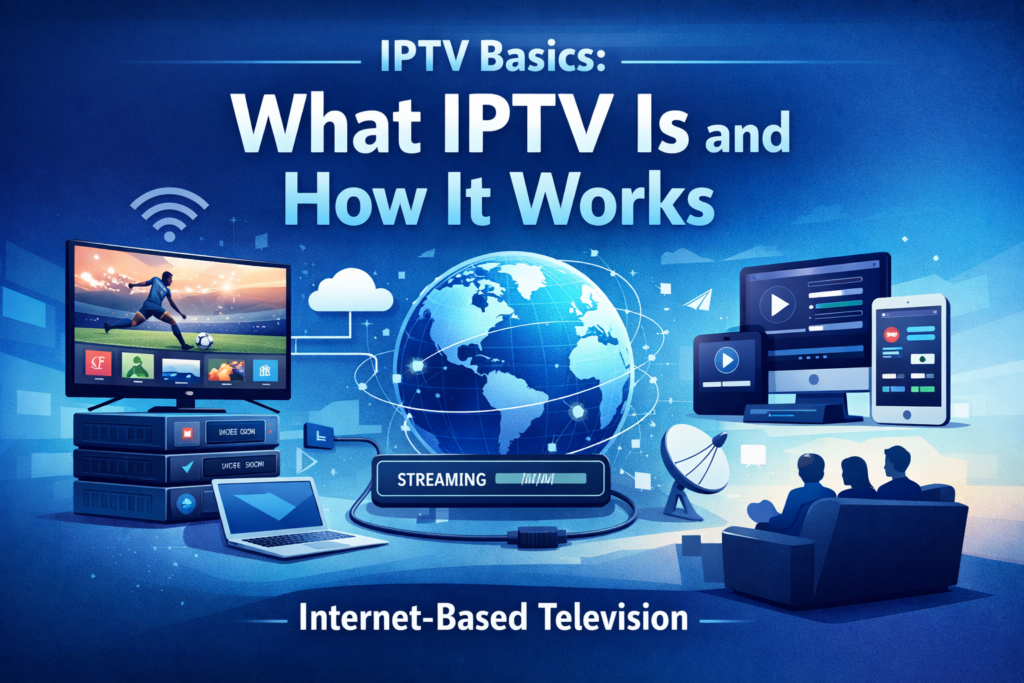
IPTV Basics stands for Internet Protocol Television.
In simple words, IPTV is a way to watch television using an internet connection instead of traditional broadcast methods like cable or satellite.
With IPTV, TV channels and video content are delivered through the internet and played directly on your screen, rather than being transmitted through physical cables or satellite signals. This allows TV content to be streamed on demand, in real time, or replayed later, depending on the service.
Unlike traditional television, IPTV does not rely on fixed schedules or dedicated broadcast infrastructure. Instead, it uses internet-based delivery, which makes TV viewing more flexible and accessible across different locations.
At its core, IPTV is about how television content is delivered, not what device you use or which application you open. Those aspects are covered separately.
Why IPTV Exists
IPTV canada exists because the way people consume television has changed.
Traditional TV systems were designed for a time when viewers had limited channel choices, fixed schedules, and were tied to one location. As internet speeds improved and global content demand increased, those systems became restrictive.
IPTV emerged as an alternative that allows television content to be delivered more efficiently and more flexibly. Instead of broadcasting the same signal to everyone at once, IPTV sends content through the internet only when it is requested or watched.
This shift makes it possible to:
- Access TV content without relying on cable or satellite infrastructure
- Watch live television and on-demand content through the same system
- Reach international channels and programs more easily
IPTV is not meant to replace every form of television for every user. Rather, it exists to offer a different way of accessing TV content that aligns better with modern internet usage and viewing habits.
What Is IPTV?
IPTV Definition Explained
IPTV, or Internet Protocol Television, is a system that delivers television content through internet-based networks rather than traditional broadcast methods such as cable or satellite.
In an IPTV system, television channels and video content are transmitted as data packets over an internet connection. These packets are received, processed, and displayed in real time or on demand, depending on how the content is accessed.
What defines IPTV is not the type of content being watched, but the method of delivery. The same types of programs found on traditional television, such as live channels, movies, or series, can be delivered through IPTV, but they reach the viewer through internet infrastructure instead of broadcast signals.
This approach allows television services to operate independently of physical cable networks or satellite dishes, relying instead on standard internet connectivity. A more detailed beginner explanation is available in our guide on what is IPTV.
How IPTV Differs From Traditional Television
The primary difference between IPTV and traditional television lies in how content is transmitted to the viewer.
Traditional television systems broadcast the same signal to all viewers at the same time. Whether a channel is being watched or not, the signal is continuously sent through cable lines or satellite transmission.
IPTV works differently. Content is delivered through the internet only when it is requested or actively being watched. This makes IPTV a more flexible system, as it does not rely on constant broadcasting.
Another key difference is control. Traditional television is built around fixed schedules, while IPTV allows users to interact with content more freely, such as accessing programs when they choose or resuming playback from a specific point.
These differences do not mean that one system is always better than the other. They simply represent two distinct ways of delivering television content, each with its own advantages and limitations.
How IPTV Works (High-Level Overview)
How TV Content Is Delivered Over the Internet
In an IPTV system, television content is delivered through an internet connection rather than through traditional broadcast signals.
The process begins with TV content being prepared and stored on remote systems designed to distribute video efficiently. When a viewer chooses to watch a channel or a program, the content is sent over the internet as a continuous stream of data rather than as a permanent download.
This data travels through standard internet networks and reaches the viewer’s connection, where it is received and displayed in real time. Because the content is streamed, playback can begin almost immediately without waiting for an entire file to load.
Unlike traditional television, where all channels are broadcast at once, IPTV delivers only the content that is actively being watched. This on-demand delivery model is a core characteristic of IPTV. A full, step-by-step explanation is available in our guide on how IPTV works.
What Happens When You Press “Play”
When you press “play” on an IPTV service, a request is sent over the internet to retrieve the selected content.
The system responds by sending a continuous stream of video data to your connection. This data is processed as it arrives, allowing the video to play smoothly while the rest of the content continues to stream in the background.
Because IPTV relies on real-time data transmission, playback quality depends on the stability and speed of the internet connection rather than on broadcast signal strength. If the connection is stable, the viewing experience can feel very similar to traditional television.
This interaction between request, delivery, and playback is what allows IPTV to support features such as live viewing, pausing, or resuming content, all within the same delivery framework.
Types of IPTV Services
Live TV Streaming
Live TV streaming through IPTV allows viewers to watch television channels in real time, just as they would with traditional broadcast television.
The difference is in how the signal is delivered. Instead of being broadcast continuously through cable or satellite, live TV channels are streamed over the internet and delivered only when a viewer is actively watching.
This means live IPTV channels follow the same schedules as traditional TV, including news, sports, and entertainment programming, but they are accessed through an internet-based system rather than a broadcast network.
Video on Demand (VOD)
Video on Demand, often abbreviated as VOD, allows viewers to watch content whenever they choose rather than at a scheduled broadcast time.
With VOD, programs such as movies or TV series are stored and made available for selection. When a viewer chooses a title, the content is streamed over the internet and can be started, paused, or resumed at any time.
This type of IPTV service is designed for flexibility and convenience, allowing users to watch content according to their own schedule rather than following a fixed programming timetable.
Catch-Up TV
Catch-up TV is a type of IPTV service that allows viewers to watch previously aired television programs after their original broadcast.
Instead of recording content manually, catch-up services make recently aired programs available for a limited period of time. Viewers can select a show they missed and stream it on demand through the same IPTV system.
Catch-up TV combines elements of live television and on-demand viewing, offering more flexibility while still maintaining a connection to scheduled programming.
These IPTV service types are explained in more detail in our guide, which breaks down how each option works in practice.
IPTV vs Traditional TV
IPTV vs Cable TV
Cable television delivers TV channels through physical cable infrastructure that broadcasts the same signal continuously to all viewers.
IPTV works differently. Instead of broadcasting every channel at once, IPTV delivers content over the internet only when it is being watched. This on-demand delivery model allows for more flexibility in how and when content is accessed.
Another key difference is adaptability. Cable TV systems are usually tied to a fixed location and require dedicated infrastructure, while IPTV relies on internet connectivity, making it easier to access content from different places.
That said, cable TV can still be a suitable option in areas where internet connectivity is limited or unstable. Both systems serve the same purpose but use fundamentally different delivery methods.
IPTV vs Satellite TV
Satellite television delivers TV signals through satellites orbiting the Earth, which transmit content directly to satellite dishes installed at the viewer’s location.
IPTV does not rely on satellite signals or dish installation. Instead, it uses internet networks to stream content directly to the viewer. This removes the need for line-of-sight to satellites and reduces dependence on weather conditions that can affect satellite reception.
Satellite TV can be effective in remote areas where internet infrastructure is limited. IPTV, on the other hand, depends entirely on internet availability and performance.
These differences highlight that IPTV and satellite TV are built on separate delivery technologies, each suited to different viewing environments and connectivity conditions.eparate technologies, each with its own strengths and limitations depending on location and connectivity.
A more detailed comparison between internet-based television and broadcast systems is available in our IPTV vs traditional TV guide.
Who IPTV Is For
Users Who Benefit Most From IPTV
IPTV is well suited for viewers who value flexibility in how and when they watch television.
People who prefer accessing content through an internet connection rather than traditional broadcast systems may find IPTV more aligned with their viewing habits. This includes users who want greater control over what they watch, when they watch it, and how content is delivered.
IPTV can also be appealing to viewers who are interested in accessing a wider range of television content without being tied to a single physical location. Because IPTV relies on internet delivery, it can offer a more adaptable viewing experience compared to traditional TV systems.
When IPTV May Not Be the Best Choice
IPTV may not be ideal for everyone.
Viewers who do not have reliable internet access or who experience frequent connectivity issues may find traditional television systems more consistent. Because IPTV depends on real-time data delivery, a stable internet connection is important for smooth viewing.
Additionally, users who prefer a very simple, fixed television experience without interacting with menus or on-demand features may find traditional TV services more straightforward.
Recognizing these limitations helps set realistic expectations and ensures that IPTV is considered as one option among others, rather than a universal replacement.
What IPTV Is NOT
IPTV Is Not an App
IPTV is often confused with the applications used to access it, but IPTV itself is not an app.
An app is simply a tool that allows users to interact with IPTV content. IPTV, on the other hand, refers to the system that delivers television content over the internet. The method of delivery exists independently of how the content is accessed.
Understanding this distinction is important because it separates the technology behind IPTV from the interface used to view it. The apps used to access IPTV are covered separately and are not part of what defines IPTV itself.
IPTV Is Not the Same as Streaming Platforms
IPTV is also different from popular streaming platforms that focus mainly on on-demand content.
Streaming platforms typically provide libraries of movies or series that are watched individually, often without live television channels. IPTV, by contrast, is designed to deliver television-style content, including live channels, alongside other viewing options.
While both rely on internet delivery, their structure and purpose are different. IPTV is built to replicate and expand the traditional television experience using internet technology, rather than replacing it with a purely on-demand model.
Clarifying these differences helps avoid confusion and sets accurate expectations about what IPTV represents.
IPTV Basics FAQ
Is IPTV the Same as Streaming?
IPTV and streaming are related, but they are not the same.
Streaming is a general method of delivering video content over the internet. IPTV is a specific system designed to deliver television-style content, including live TV, using internet-based networks. While IPTV uses streaming technology, it is structured to function more like traditional television rather than a content library.
Do You Need the Internet for IPTV?
Yes, IPTV requires an internet connection.
Because IPTV delivers content through internet-based networks, a stable connection is necessary to receive and display TV channels and video content. Unlike traditional television, IPTV does not function without internet access.
The quality of the viewing experience depends on the stability of the connection rather than broadcast signal strength.
Is IPTV Difficult to Use?
IPTV is generally not difficult to use, especially once the basic concepts are understood.
Most IPTV systems are designed to work similarly to traditional television, with channels, menus, and on-screen navigation. While there may be a short learning curve for users unfamiliar with internet-based TV systems, the overall experience is intended to be straightforward.
Understanding what IPTV is and how it works conceptually makes it easier to use any IPTV system later on.
Conclusion
IPTV represents a modern way of delivering television content through the internet, offering an alternative to traditional broadcast systems such as cable and satellite. By understanding what IPTV is, how it works, and the different types of IPTV Subscription available, it becomes easier to see how this technology fits into today’s viewing habits.
This guide has focused on the fundamentals of IPTV, providing a clear and neutral overview without going into technical setup, device choices, or legal considerations. Those topics build on the basics covered here and are best explored separately.
With a solid understanding of IPTV foundations, readers are better prepared to explore how IPTV is accessed, which devices support it, and how different services operate. Learning IPTV step by step helps ensure informed decisions and realistic expectations when moving forward.
